How Important Is Trap Position in Greyhound Betting?
Trap position can play a major role in greyhound racing, influencing a dog's run to the first bend and how well its running style suits the draw. This guide explains how trap numbers work, what trap bias means, and why trap position matters in greyhound betting.

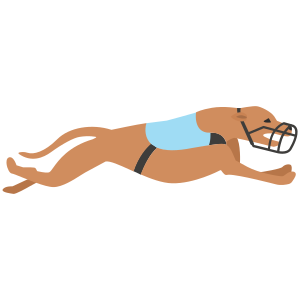 Greyhound racing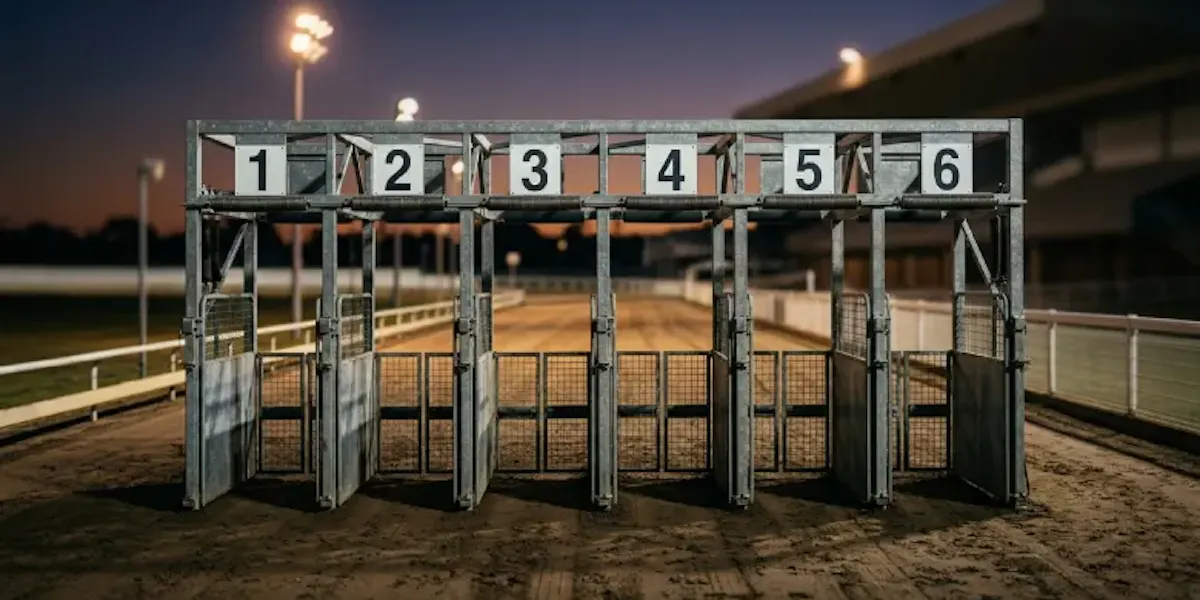
How Important Is Trap Position in Greyhound Betting?
If you’ve ever studied a greyhound racecard, you’ll know that each dog is assigned a trap number. These range from Trap 1 to Trap 6 and indicate where the greyhound will break from at the start of the race.
For many looking to place a greyhound bet, trap position is one of the first things they look at when assessing a race. But how much does it really matter?
The short answer is that trap position can be very important but its impact depends heavily on the dog, the track and the race conditions.
What is a Trap in Greyhound Racing?
A trap is essentially the starting box a greyhound runs from.
- Trap 1 is the inside rail
- Trap 6 is the outside rail (on standard six-dog tracks)
Once the race begins, dogs break from their traps simultaneously and race around the track to the finish line. Because greyhound races are often decided in the opening seconds, the position a dog starts from can influence how smoothly it gets into the race.
Why Trap Position Matters
Trap position can influence a race in several key ways:
1. The run to the first bend
The first bend is often where races are won or lost. A dog that breaks well and secures a clear path into the bend can gain a significant advantage.
Inside traps, particularly Trap 1 and Trap 2, often have a shorter route to the rail. This can be helpful if the dog naturally moves inward after the break.
2. Running style compatibility
Not all greyhounds run the same way. Some prefer to rail tightly, while others move wide.
A strong railer drawn in an inside trap is often well positioned. Conversely, a wide runner boxed in Trap 1 may find itself cramped early on.
3. Track-specific bias
Certain tracks show a tendency to favour specific traps under certain conditions.
For example, some circuits may suit early-paced inside runners, while others offer more space for wide-running dogs. This is often referred to as “trap bias”.
Inside vs Outside Traps
Inside traps (1–2)
Inside traps are often considered advantageous because they provide the shortest route to the rail. Dogs that break quickly from these positions can take control early.
However, they are not always ideal. If a dog prefers to run wide, it may struggle for room.
Middle traps (3–4)
Middle traps are often neutral positions. Dogs here have flexibility and can adjust their line depending on the break.
These traps are often suited to versatile runners who are not heavily dependent on running style.
Outside traps (5–6)
Outside traps can be a disadvantage if a dog wants to cut inside early. However, they are ideal for strong wide runners who need space to build momentum.
On some tracks, particularly those with a wide first bend, outside traps can perform very well.
When Trap Position Matters Most
Trap position tends to have the biggest impact in:
- Sprint races, where early pace is crucial
- Tracks with tight first bends
- Races with strong early-paced runners
- Competitive graded races where margins are small
In these scenarios, even a small positional advantage can make a big difference.
When It Matters Less
Trap position is less influential when:
- A greyhound has clear superior ability to the field
- The dog is a strong finisher rather than an early leader
- The race features a long run to the first bend
- Conditions reduce early speed advantages, such as heavy going
In these cases, class and form often outweigh draw considerations.
Trap Bias: The Bigger Picture
While trap position is important, it should always be considered alongside track-specific bias.
Trap bias refers to a consistent advantage for certain traps at a particular track. This can be influenced by:
- Track shape
- Bend tightness
- Running surface
- Distance
Experienced bettors often combine trap data with recent results to identify patterns that may not be immediately obvious.
Common Betting Mistake
One of the most common mistakes is assuming Trap 1 is always the best draw or that outside traps should be avoided.
In reality, the best trap depends entirely on the dog’s running style and the race setup. A well-drawn greyhound is one whose trap position suits how it runs, not simply one starting from the inside.
Summary
Trap position is an important factor in greyhound betting, particularly in races decided early around the first bend. However, it should never be used in isolation.
The most successful approach is to combine trap analysis with form, pace, grading and track conditions.
When everything aligns, a good draw can make a noticeable difference, but class and race shape often remain the deciding factors.
Understanding how trap position interacts with running style is what separates casual observation from more informed greyhound betting analysis.








 Login to play
BetWright © 2026
BetWright is a trading name of Onyx Gaming Limited, a company incorporated in England and Wales with company number 11033330. Registered office: The Coach House, Headgate, Colchester, United Kingdom, CO3 3BT. Onyx Gaming Limited is licensed and regulated in Great Britain by the Gambling Commission under account number #64666.
- Bangers N'Cash
Signup as and verifiy as an Advanced customer at BetWright to get exclusive access to opt-in rewards with our Bangers N'Cash rewards system where you can cash-in free bets and free spins every week!
- Safer Gambling
At BetWright we are committed to responsible gambling, that's why we offer a variety of tools to help you manage your gaming.
- Official Sponsorships
BetWright proudly stands as the Official Sponsor of Leyton Orient and Norwich City Football Clubs.